The Multifaceted Benefits of Community-Led Mangrove Restoration
Community-led mangrove restoration is a powerful nature-based solution that can protect coastlines, store carbon, and revive biodiversity - all while strengthening local livelihoods. By putting communities at the centre of planning and stewardship, these initiatives can deliver lasting environmental, social, and economic benefits.
Frances House
25 February 2026
Environmental Benefits
Community-led mangrove restoration is increasingly recognized as an effective nature-based solution for addressing climate change, strengthening coastal resilience, protecting biodiversity and improving community livelihoods. There are many examples from Kenya to Vietnam, Sierra Leone to India where locally-led restoration efforts are delivering sustainable environmental and socio-economic benefits for local communities.
1. Enhanced Coastal Protection and Climate Resilience
Mangroves act as natural buffers against the risks of extreme weather and sea-level rise due to climate change. A 2024 World Resources Institute report on coastal community mangrove restoration management and the transformation of local communities provides evidence of restored mangrove forests helping protect local communities from hurricanes, floods, and strong winds, reducing damage and economic losses. These deep-rooted trees slow storm surges and
stabilize shorelines, offering a nature-based defence where engineered solutions are often costly, time-consuming and carbon-intensive.
Mangrove forests build physical coastal resilience by trapping sediments, dissipating wave energy, and slowing coastal erosion - functions that are vital as climate-driven sea levels rise and storm patterns become increasingly intense. The presence of healthy mangroves can mean the difference between a village losing land, housing and infrastructure or surviving extreme weather events intact.
2. Carbon Sequestration and Climate Mitigation
Mangroves are among the most effective carbon-sequestering ecosystems on the planet, storing large quantities of carbon in their biomass and underlying sediments - significantly more carbon than land-based forests. Carbon capture through restored mangrove forests contributes to both local and global climate mitigation goals, making mangrove restoration a key strategy for countries seeking to meet their climate commitments. It also offers local communities a potential revenue stream through climate finance, as long as any blue carbon schemes are based on meaningful and on-going consultation with local community representatives, as advocated by the Global Mangrove Trust.

3. Biodiversity Recovery and Ecosystem Function
Mangrove forests act as nurseries for juvenile fish, shellfish and many more marine species. When communities restore mangroves, they often see swift environmental improvements. People involved in the Ursulo Galván project in Tabasco, Southeast Mexico, reported that fish, reptiles and birds began returning to restored areas faster than anticipated. Fish stock numbers increased with improved habitat and water quality and these levels have continued to improve as the mangrove forest matures.
A study of mangrove restoration in two deltas in Vietnam, the Red River and the Mekong, similarly highlights that in areas where restoration and conservation efforts are better integrated, healthy mangroves have increased fish yields and support sustainable seafood foraging for local communities.
4. Long-Term Sustainability
Community involvement tends to enhance the sustainability of restoration efforts. Local people understand tidal patterns, soil and water conditions, and variations in their local coastal environments far better than outside operators. When they lead restoration efforts - from planning and planting to monitoring - the likelihood that the restored mangroves will survive and flourish over time increases. This local stewardship underpins sustainable marine habitat improvements, and is an important factor in decision-making around community land use and marine spatial planning.

Community Benefits
While the environmental and ecological advantages are compelling, one of the most valuable aspects of community-led restoration is improvements to local livelihoods, food security and community cohesion.
1. Livelihood Enhancement and Economic Resilience
Mangrove restoration often creates employment opportunities for local people. In Mexico’s coastal communities, restoration workdays provide supplementary incomes — sometimes boosting household earnings from 10% up to 50%. In some cases, women involved in nursery maintenance, shellfish collection, or channel expansion contribute significantly to household incomes.
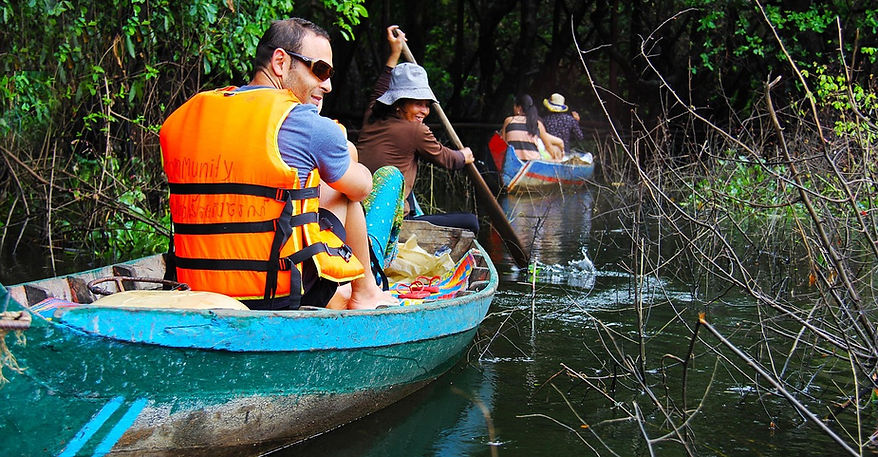
In the Vietnamese deltas, mangroves directly support economic activities like seafood harvesting, aquaculture, community recreation and, increasingly, eco-tourism. Healthy mangrove ecosystems contribute to more stable and diverse income sources, which makes coastal households more resilient to market or environmental shocks. Where effective governance and market access exist, these benefits can scale into longer-term economic resilience, enhancing community well-being and reducing vulnerability to external market pressures.
2. Strengthening Social Cohesion and Governance
Community restoration fosters collective action and ownership. WRI’s interviews in Mexico revealed that many people believed restoration improved how their communities are organized and provided “a possibility to a better future.” In places like Ejido El Palmar (Tabasco), training and workshops helped strengthen local institutions and social networks.
This aspect is echoed in Vietnam, where inclusive governance and participatory decision-making were identified as crucial for improving mangrove management. When community members are actively involved, they are more likely to support regulations that protect mangroves and ensure equitable sharing of benefits.
However, both sources also acknowledge challenges: in some communities, not everyone feels equally involved, and disputes over resource distribution can arise if benefits are not equitably shared. That underscores the importance of transparent governance structures and participatory project design to maintain social cohesion and trust.
3. Gender Inclusion and Youth Engagement
Community-led restoration can shift traditional roles and empower underrepresented groups. Women’s participation in restoration in Mexican communities opened up new opportunities for income generation and leadership, contributing to greater equity. Engaging youth through environmental education and participation strengthens community continuity and builds future stewards of the environment, ensuring that ecological knowledge and conservation values are passed down from generation to generation.
Success factors
Community-led mangrove restoration delivers transformative environmental benefits: coastal protection, enhanced biodiversity, carbon sequestration, and long-term ecosystem stability. These gains are amplified when restoration is rooted in local knowledge and ownership. Such initiatives have succeeded in countries such as Kenya, Sierra Leone, Vietnam, India, Mexico and beyond by combining local ownership, inclusive participation, economic incentives, and strong partnerships.
Studies show that when communities are empowered and financed to protect and restore coastal ecosystems, environmental gains - from ecosystem restoration and improved biodiversity to climate resilience - go hand-in-hand with social and economic benefits such as improved food security, more sustainable livelihoods, stronger economic resilience, strengthened governance and social cohesion, and gender empowerment and job diversification.